
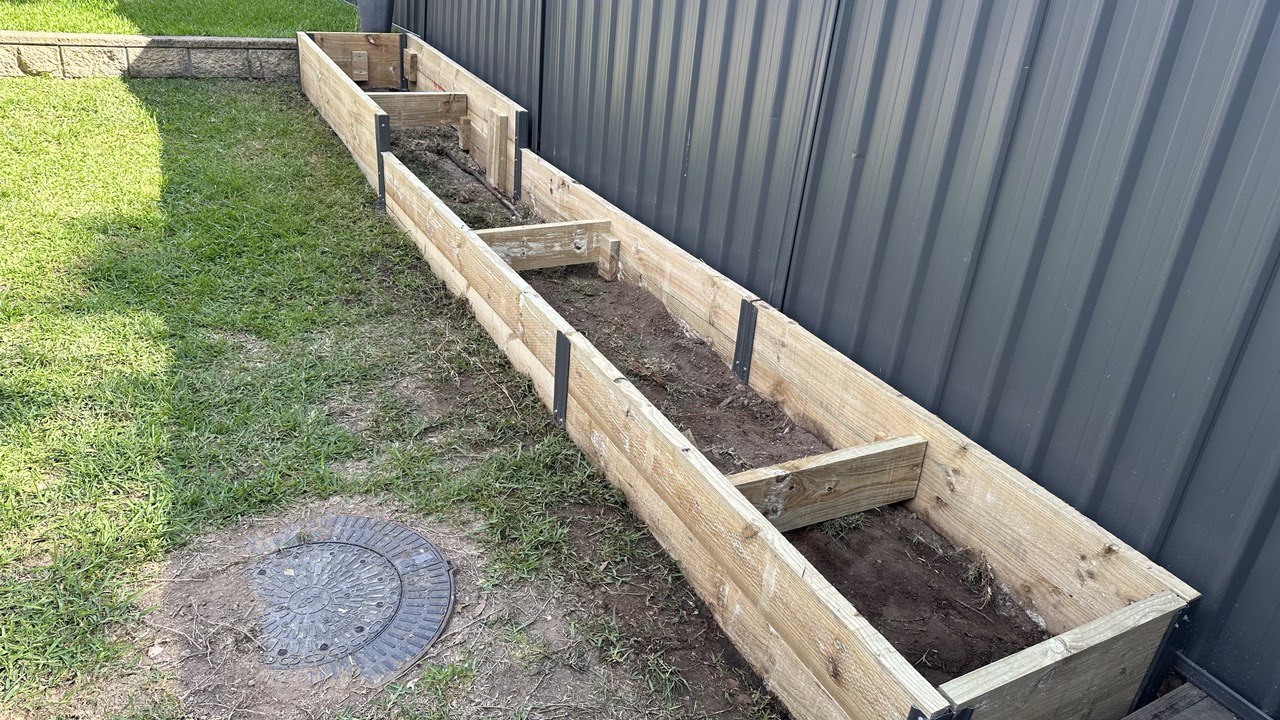
Treated pine sleeper garden boxes built on galvanised steel posts, stepped to follow the fall of the block. The warm, natural option — and the quickest way to turn a bare strip along a fence into something worth looking at.
What timber garden boxes are good at
Timber is the fastest and most affordable way to build a raised bed, and it’s still the one most people picture when they think “garden box”. It suits vegetable and herb beds, garden edging along a fence line, and terracing a yard that slopes.
It also looks warm in a way masonry doesn’t. Against a Colorbond fence or a rendered wall, timber softens the whole thing. In a garden that’s already got a lot of hard surfaces, that matters.
How we build them
Sleepers slotted between galvanised steel posts, not timber posts.
That’s the detail that decides how long the box lasts, and it’s the one most DIY builds get wrong. A timber garden box almost never fails in the middle of a sleeper — it fails at the posts, right at ground level, where the timber is in permanent contact with wet soil on one side and air on the other. That’s the zone where rot starts.
Galvanised steel posts take that failure point out entirely. The sleepers sit in the channel, the steel does the structural work, and the timber isn’t relied on to hold anything up. If a sleeper ever does need replacing years down the track, it slides out and a new one slides in. You don’t rebuild the box.
- H4-treated pine sleepers — rated for in-ground contact, which is what a garden box actually is
- Galvanised steel posts concreted in, taking the structural load
- Drainage set up before the box is filled, not after
- Lining to the inside face where it’s worth it, to slow the soil-to-timber contact
Working with a slope instead of against it
Most Sydney backyards fall away somewhere. You’ve got two choices with a garden box on a slope: build it level and let the ground run away underneath it, which looks wrong and leaves gaps, or step the box down in sections to follow the fall.
Stepping is more work. Each section is set individually, and the posts have to be right or the whole run reads crooked. But it’s the difference between a box that looks like it was designed for the yard and one that looks like it was dropped into it.
alt: “Timber sleeper garden boxes filled with soil and planted out along a Sydney fence line”
Worth adding — right now the only photo shows the boxes before filling.
How long timber lasts, honestly
Less than masonry. That’s just true, and anyone telling you otherwise is selling something.
Timber in permanent soil contact has a finite life, even treated and even built well. What changes the number significantly is how it’s built: steel posts instead of timber ones, drainage so the box isn’t sitting in water, and lining the inside face so the soil isn’t in direct contact with the timber all year round.
Done that way, timber gives you a long service life at a fraction of the cost of blockwork. Done badly — sleepers stacked on timber posts, no drainage, no lining — you’ll be looking at soft, spongy posts inside a few years.
If you’re growing vegetables
Worth a thought. Treated pine gets its rot resistance from preservatives, and while modern treatments used for garden timber in Australia are considered suitable for the job, plenty of people prefer not to have treated timber in direct contact with soil they’re growing food in.
Simple fix: line the inside face. It separates the growing soil from the timber and costs very little at build time. If you’d rather avoid treated timber altogether, untreated hardwood is an option — it costs more and still has a finite life, but it’s a legitimate choice for an edible garden. Tell us at quoting stage and we’ll build it the way you want.
Timber or masonry?
Go timber when
Budget matters, you want it done quickly, you like the warmer natural look, or it’s a vegetable bed you’re happy to refresh eventually. Also the better call on a slope where stepping is needed.
Go masonry when
You want it built once and never again, the boxes need to match a rendered or brick house, or the box is doing structural retaining work rather than just holding garden soil. See our rendered garden boxes and split-face block boxes.
We build both, so we’ve got no reason to push you one way. On a first visit we’ll tell you which one actually suits the site and the budget.
At a glance
- Timber
- H4-treated pine sleepers, or hardwood on request
- Posts
- Galvanised steel, concreted in
- Suits
- Vegetable and herb beds, fence-line garden strips, terracing a sloped yard
- Slopes
- Stepped in sections to follow the fall of the land
- Drainage
- Set up during the build, before filling
- Where we work
- Greater Sydney, based in West Ryde
- Quotes
- Free on-site look and a written price
Thinking about garden boxes?
Send us a photo of the area and rough measurements. We’ll tell you whether timber or masonry makes more sense for your yard, and what’s involved. No pressure either way.