
Most people pick a gate by looks. But whether a sliding or swing gate will actually work is decided by your driveway: its slope, how much space you have beside it, and how close the gate is to the street.
Here’s how to work out which type your home needs.
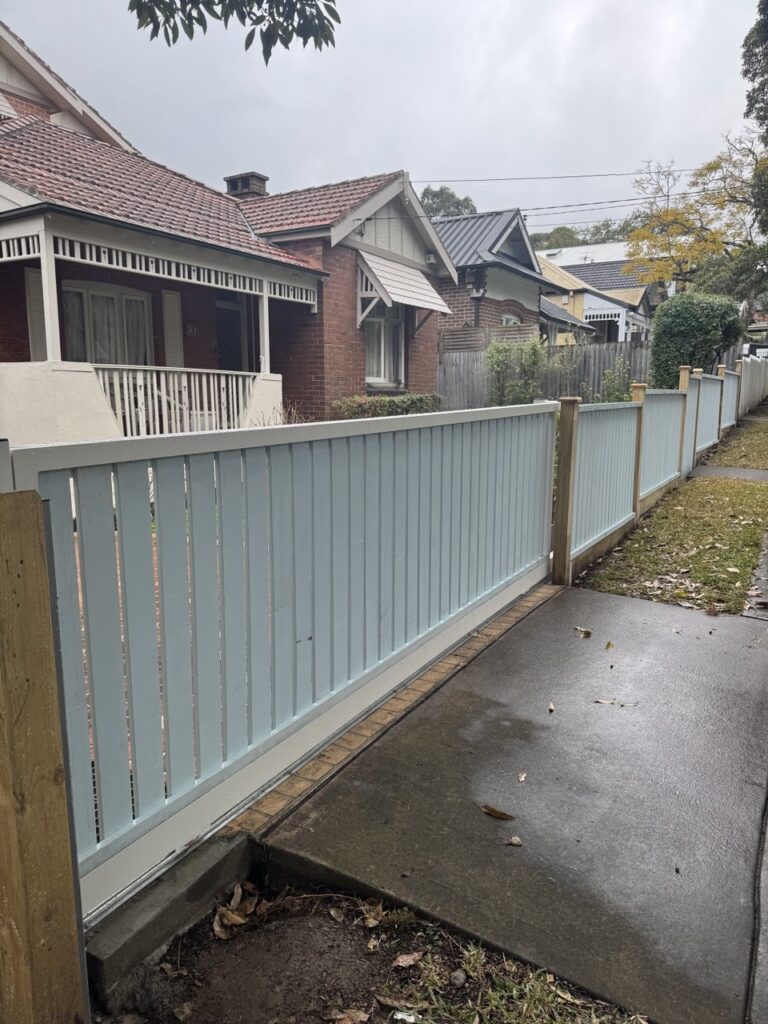
How each type works
- Sliding gate. One panel rolls sideways along a track, or is supported on wheels, parallel to your fence.
- Swing gate. One or two leaves open on hinges, like a door, into your property.
Choose a sliding gate if…
- Your driveway slopes up from the street. A swing gate opening uphill would hit the ground. A sliding gate runs across the flat line of the boundary.
- You don’t have room for the gate to swing. Short driveways, or cars parked close behind the gate, suit a slider.
- You have fence space beside the opening. A slider needs a clear run of fence at least as long as the gate itself, so it has somewhere to slide.
- It’s a windy spot. A sliding gate is less exposed to wind loads than a large swinging leaf.
Choose a swing gate if…
- The driveway is flat or falls away from the gate (so the leaves clear the ground when they open).
- There’s no room to the side for a sliding gate to run back.
- You want a traditional look or a pair of matching leaves.
- You have space inside the boundary for the full swing arc, clear of cars, bins and garden beds.
Side-by-side
| Sliding | Swing | |
|---|---|---|
| Sloping driveway | Handles uphill slopes well | Needs flat or falling ground on the swing side |
| Space needed | Clear fence run beside the opening | Clear arc inside the property |
| Wind | Less affected | Large leaves catch wind |
| Speed | Opens in one straight movement | Similar. Double leaves can open faster |
| Track / ground work | Track or footing along the run | Hinge posts and footings |
Safety features to ask about
An automatic gate is heavy moving machinery. Ask whether your gate will have:
- Safety beams (photo-electric sensors) that stop the gate if a car or person is in the way
- Obstacle detection in the motor, so it stops and reverses on contact
- Manual release for power outages
- Battery backup, if you need the gate to work in a blackout
Materials and access
Timber-look aluminium, slat aluminium and solid timber all work as sliding or swing gates. Choose the look, then match the motor to the gate’s weight and size. Access can be by remote, keypad, intercom, or app. We cover motors, materials and access options in detail in our complete guide to automatic gates.
Not sure which will work?
We measure your driveway slope, the fence space either side and the swing clearance, and tell you which type suits before you choose a design. See automatic gates in Sydney or call 0475 424 078.
Frequently asked questions
Can a swing gate open outward onto the footpath?
Gates generally must not open over a public footpath or road. Swing gates open into the property.
Can I automate my existing gate?
Often, yes, if the gate is sound and the right weight for a motor. We’ll check the frame, hinges or track first.
What if my driveway slopes sideways?
Cross-slopes can be handled with a sliding gate and stepped track, or with rising hinges on a swing gate. It depends on how steep it is.