
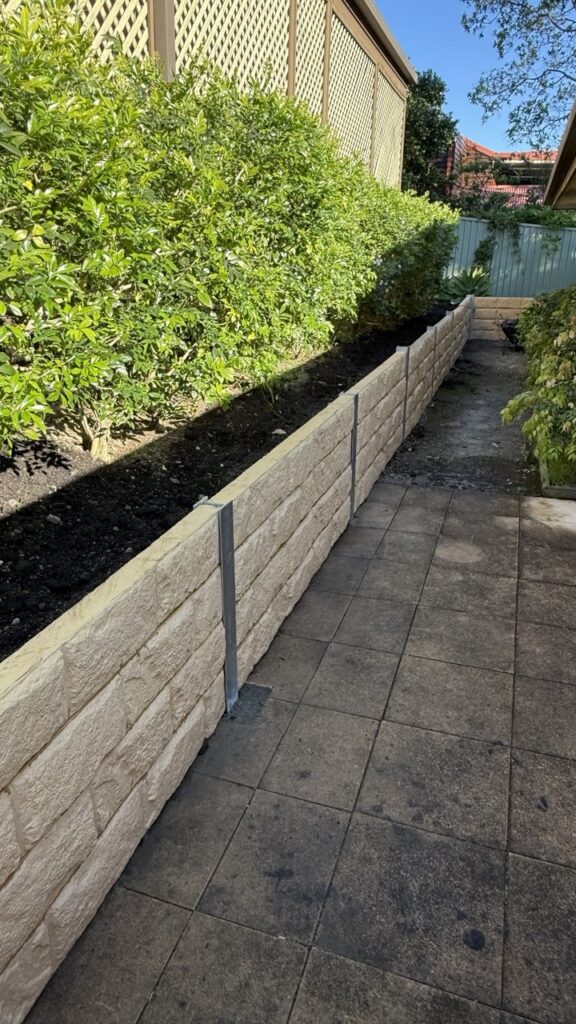
Around 30 metres of tired timber garden boxes replaced with split-face concrete block — a stone-textured finish that will outlast timber several times over.
The brief
The property already had garden boxes, but they were built in timber and had reached the end of their working life. Timber garden boxes have a hard job — they sit in constant contact with damp soil on one side and weather on the other, so even treated timber eventually softens, warps and lets go at the joints.
Rather than rebuild in the same material and face the same problem again in a few years, the owners wanted something permanent.
Why split-face concrete block
Split-face block is concrete masonry that has been split rather than cut, so the exposed face has a rough, natural stone texture instead of a flat machine finish. It gives the boxes the look of stacked stone while behaving like solid masonry.
- Texture — the split face reads as natural rock, which suits a garden setting far better than smooth blockwork
- Colour range — available in greys, charcoals and warmer sandstone tones, so the boxes can be matched to the house and paving
- Longevity — masonry does not rot, warp or need replacing the way timber does, which is the whole reason for the change
- Structure — strong enough to hold soil, water and planting without bowing over time
For this job we used a warm sandstone tone to sit comfortably against the existing paving and fencing.
What we built
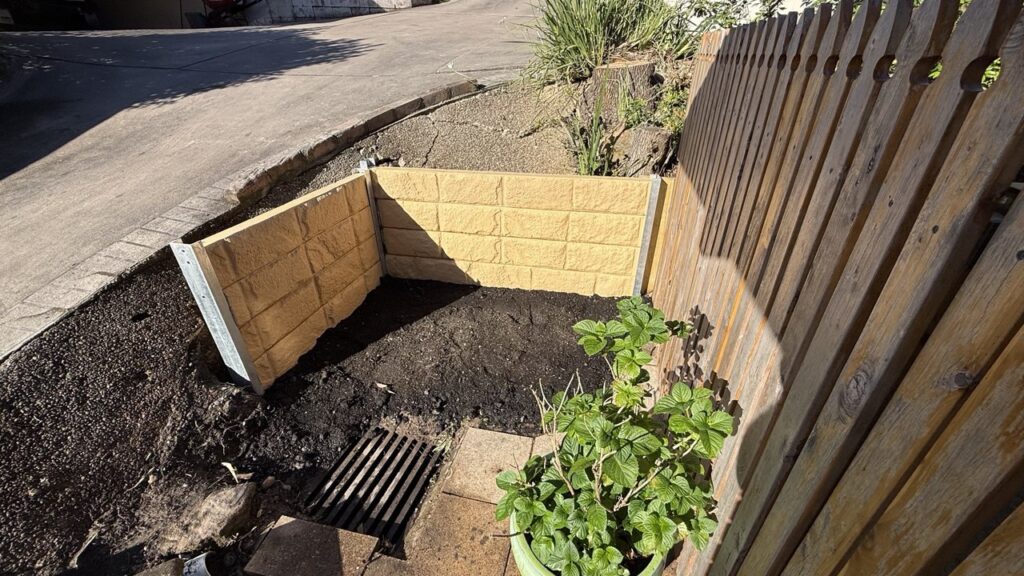
Roughly 30 metres of garden boxes in total, running along the walkway and returning around the corner sections of the yard. The old timber boxes were removed, the ground prepared, and the new block boxes built, backfilled and planted out.
Drainage was set up as part of the build rather than dealt with afterwards — garden boxes hold a lot of wet soil, and water needs somewhere to go if the structure and the plants are both going to last.
Project details
- Location
- Eastwood, Sydney
- Scope
- Removal of existing timber garden boxes and construction of split-face concrete block garden boxes
- Length
- Approximately 30 metres in total
- Material
- Split-face concrete block, sandstone tone
- Replaced
- Original timber garden boxes
The result
The boxes now match the permanence of the rest of the property instead of being the element that needs redoing every few years. The split face keeps the garden feeling natural rather than hard-edged, and the sandstone tone ties the boxes to the paving and fence line.
Practically, this is the last time these garden beds will need rebuilding. That is usually the deciding factor when people weigh block against timber — the up-front difference is modest, and the replacement cycle disappears.
Thinking about garden boxes or raised beds?
Whether you are replacing timber that has given up, or building raised beds from scratch, we will look at the site and talk through materials that suit the space and the budget.