
Good news first: many backyard pergolas in NSW don’t need council approval. If your pergola meets a set of state-wide rules, it counts as “exempt development” and you can build it without a development application.
If it doesn’t meet the rules, it can still be approved. It just takes a different path. Here’s how to tell which one you’re on.
This is general information, not legal advice. The rules below come from the NSW State Environmental Planning Policy (Exempt and Complying Development Codes) 2008. Always confirm for your property.

When is a pergola exempt development?
A pergola can be exempt if it is not built on a heritage item (or draft heritage item) and not on land in a foreshore area, and it meets all of these standards:
Size
- No more than 25 m² in area.
- The total floor area of all decks, patios, pergolas, terraces and verandahs on the lot is capped: 15% of the ground floor area of the house on lots over 300 m², or 25 m² on lots of 300 m² or less.
Height
- No higher than 3 m at its highest point above existing ground level.
- If attached to the house, it can’t extend above the roof gutter line.
- Floor height (if it has a deck or patio floor) no more than 1 m above ground.
Position
- Behind the building line, so not in your front yard.
- At least 900 mm from each lot boundary in most residential zones (5 m in some rural and large-lot zones).
Construction
- Roof overhang no more than 600 mm on each side.
- Metal parts in low-reflective, factory pre-coloured materials.
- If it’s fixed to the house fascia, connected to a professional engineer’s specifications.
- Roof water directed into your existing stormwater system, without blocking existing drainage.
- On bushfire-prone land, within 5 m of the house, built from non-combustible materials.
- No enclosing walls higher than 1.4 m.
If your pergola ticks every box, no council approval is needed. It still has to be built properly and meet the Building Code of Australia.
What if my pergola doesn’t fit the rules?
Common reasons a pergola falls outside the exempt rules:
- It’s bigger than 25 m², or pushes your total over the cap.
- It needs to sit closer than 900 mm to the boundary.
- It’s in the front yard.
- Your home is heritage-listed or in a foreshore area.
In those cases there are two usual paths:
- Complying Development Certificate (CDC). A faster approval from a council or private certifier, if the design meets the complying development standards.
- Development Application (DA) through your council, for designs that don’t fit either code.
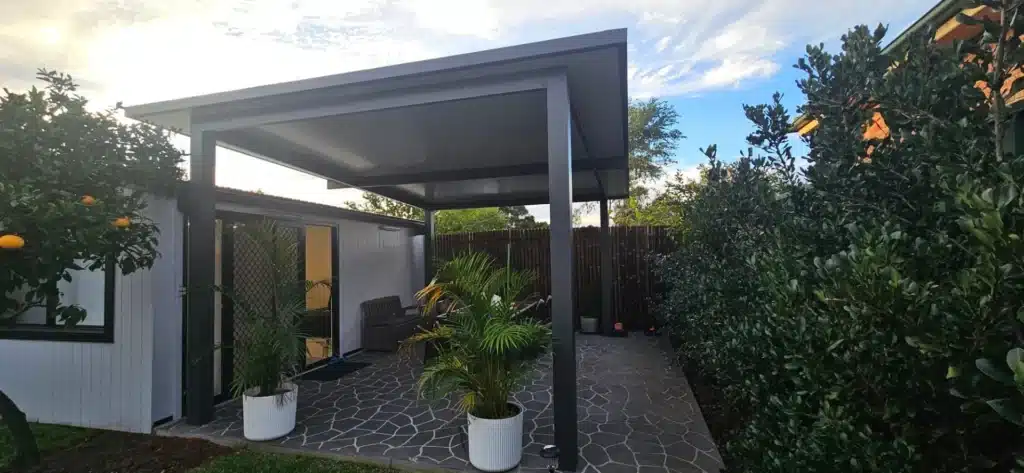
Pergola, carport or patio roof: does it change the rules?
Yes. Carports have their own rules. For example, carports have different size limits, and garden sheds have separate rules too. If your “pergola” will mostly shelter a car, it may be assessed as a carport. We can help you work out which rules apply.
How we handle it
At the free site visit we measure your block, check boundary distances and the gutter height, and tell you whether your design fits the exempt rules. If it doesn’t, we’ll suggest a way to adjust the design so it does, or explain the approval path.
See our pergola, carport and garden shed installation service, or browse pergola styles first. Call 0475 424 078.
Frequently asked questions
Can I build a pergola on the boundary without approval?
Under the exempt rules, a pergola in most residential zones must be at least 900 mm from each boundary. Closer than that usually needs approval.
Does a louvred or solid-roof pergola need approval?
Roofed pergolas can still be exempt if they meet all the standards, including height, gutter line, overhang and stormwater.
Where can I check the rules myself?
The NSW Planning Portal (planningportal.nsw.gov.au) has an exempt development guide, and your council can confirm whether your property is heritage-listed or in a foreshore area.
Source: NSW Legislation, State Environmental Planning Policy (Exempt and Complying Development Codes) 2008, clauses 1.16, 2.11–2.12 and 2.19–2.20 (version in force from 11 September 2026, accessed 29 September 2026). This article is general information only and is not legal advice. Rules can change, so check the current legislation or with your council before you build.